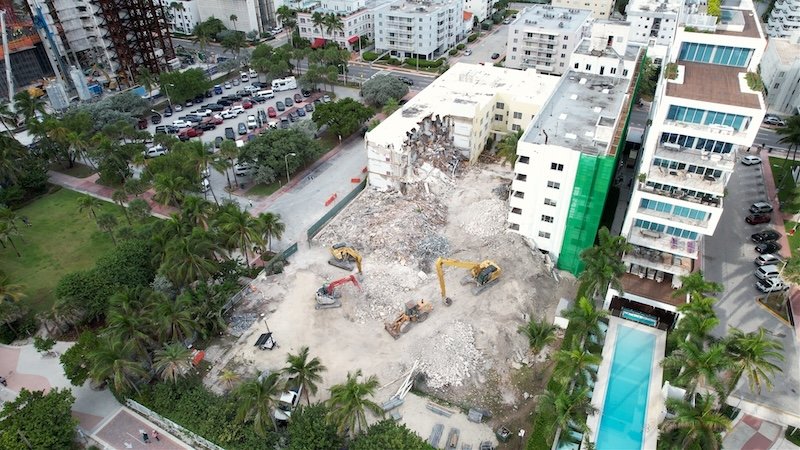
Demolition work is now underway at the historic Coral Reef Hotel and Patrician Hotel, two long-standing Collins Avenue properties that once anchored a prominent stretch of Miami Beach’s mid-century resort corridor. Heavy equipment began removing structural sections this week, signaling the end of the era for buildings that had been part of the city’s architectural identity for decades.
The properties are being redeveloped by 13th Floor Investments, which proposes replacing the hotels with a luxury residential condominium developed in partnership with the Cipriani brand. According to project filings, the new development would carry the Cipriani name and luxury accommodations.
This activity follows recent changes to Florida law that preempt local regulations for buildings designated as “unsafe.” Under the statute, municipalities can no longer rely on local preservation rules to delay or prevent demolition orders when buildings meet the state’s threshold for structural risk. These two hotels are the first officially designated local landmarks in Miami Beach to be cleared under this new legal framework.
Preservation advocates opposed the project: the Miami Design Preservation League (MDPL) formally registered its opposition, arguing that the architectural and cultural significance of the buildings justified retention rather than demolition. Meanwhile, commission candidate Daniel Ciraldo — formerly of the MDPL — authored an open letter addressed to the Cipriani family of Venice. In his letter he wrote:
“With deep respect for your international legacy in hospitality, culture, and historic preservation … I write to you today with an urgent plea: Please reconsider the proposed total demolition of the two historic buildings at 36th Street and Collins Avenue in Miami Beach.”“We believe strongly that world-class design and preservation can coexist. … There are creative solutions that honor both legacy and innovation.”
No legal action has been taken by the municipality or any local advocacy groups to contest the application of the state preemption in these cases. That absence of challenge allows the demolition to proceed under the new state framework, which effectively limits the city’s ability to weigh historical value when safety determinations are triggered at the state level.
As demolition progresses, the developers 13th Floor are already promoting the new Cipriani residences, which will start at $23MM.
For many residents and observers, the loss of these buildings underscores how the unprecedented state authority over local historic-preservation practice is reshaping the historic landscape of Miami Beach.