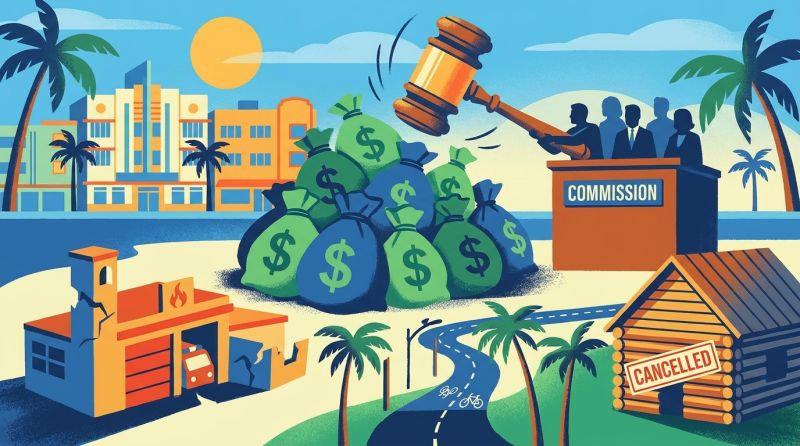
A pattern of last-minute reversals by the Miami Beach City Commission on voter-approved capital projects has squandered close to $9 million in public funds, according to a quarterly report filed July 16, 2026, by Inspector General Joseph M. Centorino with the Mayor and City Commission.
The report, OIG No. 26-13, covers the status of the 2018 General Obligation Bond Program and delivers its sharpest rebuke yet of a recurring practice: commissioners stopping or fundamentally redirecting projects after years of design work — typically in response to objections from a small number of residents — and over the explicit objections of city staff and the G.O. Bond Oversight Committee.
Program at a Glance
The Office of the Inspector General reports that the G.O. Bond program continues to advance overall. Of the $261.8 million allocated to Tranches 1 and 2, $146.5 million — or 56% — has been spent or encumbered. Of 47 active tranche projects, 94% are either complete or currently underway.
Tranche 1 is significantly further along: 86% of its $160.73 million appropriation ($138.25 million) has been spent or committed, and 96% of its 92 subprojects are complete or active. Tranche 2 lags behind, with only 8% of its $101.1 million budget ($8.23 million) spent or encumbered and 9 of 15 subprojects active.
Fire Station #1: The Cautionary Tale
The report traces the current pattern of waste to Project #45, the reconstruction of Fire Station #1. The original design services contract was $999,917. Two amendments added $571,037 and $93,669 respectively, bringing the design contract to $1,664,623. The Commission then voted to redesign the station for a different location, adding $2,611,752.34 and raising the total design contract to $4,276,375 — despite administration projections that a relocation redesign would cost $15 to $20 million and that finding additional funding would be difficult.
The total Tranche 1 appropriation for the fire station was $5,746,058. After the design overruns, only $477,729.76 remained. Staff was then directed to spend additional time and resources searching for a new site — a search that ultimately led back to the original location, consuming an additional 500 city staff hours in the process.
The OIG classified the Fire Station #1 project as an example of "waste" under GAO standards and recommended a process reform requiring a supermajority Commission vote to alter any project that has advanced past the 30% to 60% design phase.
The 34th Street Bike Path: $581,548 Gone, Grant Lost
Project #43, the Chase Avenue/34th Street Shared Use Path, was a top priority in the city's 2015 Transportation Master Plan and was approved by the Commission in October 2019. Design services began in May 2021 under a $179,837 contract. The project secured a $495,075 FDOT grant after the city agreed to make the path uniform in width.
Over the next several years, the Commission repeatedly referred the item back to committee rather than authorizing construction. On January 31, 2024, the Commission approved a new design option — resetting the permitting clock on what had been described as a "shovel ready" project and delaying it by nearly a year.
On February 25, 2026, the Commission voted unanimously to cancel the project, citing what it called estimated savings of $1,191,776. But at the G.O. Bond Oversight Committee meeting on July 9, 2026, members learned the full picture: $581,548 in G.O. Bond funds had been spent and was unrecoverable, the $248,452 remaining may be redirected to another G.O. Bond project, and the $495,075 FDOT grant has been permanently lost and cannot be applied elsewhere.
The committee also learned that no alternative route for a dedicated bike path along Chase Avenue and 34th Street exists, meaning the opportunity for safe cycling infrastructure in that neighborhood is gone entirely.
The project's funding at the time of cancellation, per the OIG report:
| Funding Source | Budget | Total Spent/Encumbered | Balance |
|---|---|---|---|
| 3 Cent Local Gas Tax | $945,000 | $0 | $945,000 |
| FDOT Grant | $495,075 | $0 | $495,075 (lost) |
| 2019 G.O. Bond (Neighborhood) | $830,000 | $581,548 | $248,452 |
| TOTALS | $2,270,075 | $581,548 | $1,688,527 |
The Log Cabin: Still Unresolved, Costs Rising
Project #27, the North Beach Historic Log Cabin, is described in the report as "the latest example" of the Commission starting, stopping, and changing the scope of a project in its late design phase. The Commission first resolved in June 2018 to reconstruct the Log Cabin — remnants of which are in storage — as a historic mixed-use community space inside North Shore Oceanside Park, a short distance from its original site at 8128 Collins Avenue. The park was selected for its better access to utilities and proper elevation.
After delays in Tranche 2 funding, the Commission unanimously moved the project into Tranche 1 in April 2024 with a $1,076,000 budget, temporarily drawing from the North Shore Track and Fields and Skate Park project funds. By April 2025, design services were underway with an expected eight-month timeline, and the project was on track to go out for bid in early 2026.
Then, in September 2025, committee members reversed course — stating that residents wanted the Log Cabin returned to its original location in the "west lots" across the street from the park. The OIG notes the reasoning was "unrelated to design or construction issues but rather an emotional attachment held by some residents to the former site." Despite that reversal, the Design Review Board approved the park-location design on November 25, 2025.
On December 17, 2025, the Commission again referred the project to committee to explore returning it to the original site. By the March 30, 2026 committee meeting, the project had reached 90% design completion for the park location and was scheduled to go to bid in summer 2026. Staff advised that relocating the Log Cabin would require a complete redesign and add more than $1 million in cost.
On April 22, 2026, the Commission unanimously passed a resolution on the consent agenda to pause all design work — contradicting its earlier directive to staff to "act with urgency" — in order to evaluate incorporating the Log Cabin into the larger west lots development.
The Administration has strongly opposed the relocation, citing three fiscal pressures: a Commission directive to prepare the FY 2027 budget under a rolled-back millage rate that may require up to $25 million in spending reductions; an increasingly unfunded Capital Improvement Program; and state-level proposals to eliminate or significantly reduce property taxes, which represent 62% of the city's General Fund revenue. The estimated additional cost of relocation is $1,106,100.
'Stop the Pause II' Ordinance: A Reform That Came Too Late for All Three Projects
Following the Fire Station #1 saga, the Commission adopted a "Stop the Pause" ordinance creating higher voting thresholds for altering critical infrastructure projects over $1 million at advanced design stages. The OIG supported the measure. On June 24, 2026, the Commission unanimously passed an amended "Stop the Pause II" ordinance extending those protections more broadly to capital improvement projects over $1 million in late design stages, while also requiring greater budget transparency and resident notification.
The report notes that all three projects flagged in this review — Fire Station #1, the 34th Street Path, and the Log Cabin — had reached 90% design completion with budgets exceeding $1 million, and that had "Stop the Pause II" been in effect earlier, it would have applied to each of them.
A key provision of the new ordinance requires any motion to pause or stop a qualifying project to include "a detailed estimate of additional costs expected to be incurred." The OIG further recommends that such votes be placed on the regular Commission agenda for open discussion rather than the consent agenda — a vehicle that allowed multiple consequential Log Cabin votes to pass without debate.
OIG Recommendations
The report urges the Commission to strongly consider returning the Log Cabin to its approved, 90%-designed location in North Shore Oceanside Park, arguing that the $1.1 million in relocation costs would be better directed toward other North Beach needs. It also calls for reaffirming the advisory authority of the G.O. Bond Oversight Committee to ensure capital decisions align with fiscal constraints.
"Such practices weaken public confidence, delay vital community improvements, and jeopardize the financial stability of the G.O. Bond program itself," the report states. "At a time when the City is struggling to find ways to cut its budget, including hiring freezes, mandatory department reductions of 5%, and other strategies, it is incumbent on City leadership to exercise fiscal restraint. City taxpayers deserve no less."
The combined waste from all three projects now approaches $9 million, the OIG concludes — an avoidable toll the Inspector General attributes directly to "inconsistent direction, unnecessary redesigns, and pauses issued in conflict with professional recommendations and established project timelines."
The full report, OIG No. 26-13, is available from the Office of the Inspector General at 1130 Washington Avenue, 6th Floor, Miami Beach, or by calling 305.673.7020.